Ah, the most controversial issue about a Muslimah: the Hijab.

Every non-Muslim woman wonders why a Muslimah covers her hair.

Then the non-Muslim woman sees a Muslimah with the niqab: Oh, dear...
 Then she walks past a Muslimah in a full niqab (eyes covered as well): Oh, my...
 Lastly, she comes upon a Muslimah dressed in a burqa: Dear Lord, what oppression!
I come from two worlds. There is a clear line drawn between these two worlds of mine: the old and the new. You see, for 23 years, I was a Roman Catholic; a denomination of Christianity that holds strong to its roots, traditions and the Catholic Bible. I was raised by a mother who grew up in a Catholic convent, I attended Sunday school, was baptized at the age of 12, confirmed at the age of 16 (I think), attended Sunday mass regularly, and attended a school originally founded by priests and nuns, located right next to a Cathedral. I knew my Our Father, my Hail Mary, etc... I was not exactly a fan of Muslims (stress on the word Muslims... not Islam) but because of that, my opinions on Islam varied accordingly.
Then all that stopped and ended, much to my mother's disappointment and my family's objection. On the 8th of October 2011, I did something all my high-school friends thought was the craziest thing I have ever done; I said my shahadah in front of my friends here in the university I attend. Some didn't know until the appointed 'imam' announced and lead me through my shahadah. Some cried, some smiled... I was just bemused.
So, given my history, I see things from two sides. I understand what a non-Muslim thinks about Muslims and Islam and I understand personally how it is being a Muslimah.
The aspect of my change is wide, it is not just a change of heart and fashion, but also a change in mentality and how I view what goes on in the world as well.
But since the topic I chose to share today is about the Hijab, I will stick to this. It is already a big topic but hey, I'm not Wikipedia :P
So...
The Hijab. I started wearing the hijab much earlier before I embraced Islam, say... 4 years prior to 2011? heheh... it just started out as curiosity. Since I was away from home, and for the first time in my life, I actually have Muslim friends who I feel close with. So I just thought why not? It'll be a new experience! And it was. It was not as uncomfortable as I imagined it would be and not ugly. With or without the hijab, I still felt pretty, but when I walk out the door with my hijab, it's a different kind of pretty. Something more private, something more mysterious and something more fulfilling.
Of course, that sparked a lot of talking among my friends and other students and some teachers as well. My Christian friends (at this time I was involved with many Christian programmes) were well, they weren't hostile but they didn't agree with my actions. I remember one friend, a senior suggesting that instead of wearing a hijab, I should wear the habit instead. That sparked quite a heated conversation between us and our friendship was never the same after that. But I stood my ground for as long as I could. It finally got too much so I stopped.
The hijab never really left me. The feelings stayed with me as I went through the roughest time my faith endured. It got so rough, to a point I refused to believe in anything.
Then 2011 came. For the first time since I went abroad for my studies, I decided to go for a trip. A bunch of my Muslim friends were going to Egypt during our winter holidays and within one day, I convinced my other friend (a Christian Chinese) to accompany me. So, we embarked on that trip, happy and excited, oblivious to the chaos that laid awaiting us in Egypt. But when Allah has a plan for you, you sometimes go blind: in my case, I ignored the news concerning the bombing in Domodedovo the day prior to our little group's departure for that same airport, and all 9 of us ignored the news about the uprising in Tunisia and Egypt.
Free from prying eyes and opinions, I was again free to wear my hijab. Oh, how wonderful it felt putting on my hijab as the Azhan rang in the air. And that was it, Egypt was my platform. I boarded the train and never turned back.
A persons journey to Islam may start with intense study of different religion, some through observing a Muslim friend closely, others through instant revelation, but my journey to Islam started with one simple piece of square cloth; the Hijab
1. The hijab
2. Aurat
3. Hijab styles
4. Abaya
5. Makeup
6. Eyebrows
7. Perfume
 A hijab is not just a cloth that covers ones head, hair and neck, but it covers ones treasure. You know how we women treasure our beauty. We love being beautiful, that's why the cosmetic industry is one of the most marketable and profitable industries. Every woman on this earth loves looking pretty. But beauty differ according to culture and individual. Everyone has a certain beauty about them even if others do not see it. If you have a gold bar, you don't go showing it off, do you? No. Instead, you keep it in a safe, or in the bank behind several inches of metal. So, why should a woman's beauty be any different? It is HER treasure. So, in Islam, we say, hide it. Do not be common and decrease your value by showing it to just anyone. It is for you to share with your husband.
That's the basic idea of a hijab. The most basic. To go further deeper, the hijab also helps the men. Girls, you know how men are, and men, you know yourself. A man sees a pretty lady, and he turns to look for a second time, looks at her face, then her chest, then that nice piece of *** then the oh so sexy slim legs. WOW!! that's a hot mama right there! It's how men are programmed. It's their natural instinct. If it stops there, then that's fine, but very few men just stop there. They continue to wonder how all that feels to his touch, etc. Majority have the discipline to control that basic human urge, but still, show some pity to the poor man!
If a woman is covered up from head to toe (not necessary in a burqa) what's there for a man to see? He can't know if she is to his liking or not. What chest to see? What *** to admire? What legs to stare at? It's all covered up, in long loose clothing. He can't see the pretty hair or the nice slim neck that's hidden under then hijab. He can't see the pretty lips curved in a smile behind the niqab. He can't see the pretty eyes sparkling behind the veil. What he can't see, he won't think about. When there's nothing for him to think about, he's not gonna have urges. Sisters, help your brothers, don't torment them with your beauty.
Not only that, you also earn their respect. A man will not disturb a woman who is covered up. He knows that she is not to be played with. He knows that she is to be respected. He knows that her dignity is to be honoured. We women dream of the knight in shining armour, the honourable gentlemen who treats his lady with respect. Well, there he is. He respects you, he honours you, but before you ask all that from a man, you have to show that respect and protect that honour yourself! That is why a Muslimah wears her hijab. That is why a Muslimah covers her aurat. Allah gave her beauty and she obeys and covers herself.
The hijab should be low enough to cover her chest. Why? It's obvious.
Aurat
When speaking about the hijab, we explain the aurat. Aurat is everything that should be covered. For women, it is everything except the face and hands. The FEET is also part of the aurat!! Though many of us forget that. So, a woman can be seen in public or by non-mahrams (men she can marry) when she is covered fully, except for her hands and face. So, the niqab is not compulsory, but should a woman choose to do so, then better for her. But if a woman is still not able to bring herself to such a level, then she looses nothing.
If a woman covers her head but wears a tight blouse or a short skirt with leggings, then her aurat is still exposed. She might as well just remove the hijab. To cover ones aurat, it is not just putting a cloth over it. The shape of the body should not be seen. You're not suppose to wrap your aurat, you're suppose to cover it. What's the point of wrapping the vase tightly with a cloth? You still know it's a vase even if you can't see it. Same with the aurat. A man can still see the shape of your ass and breasts when you wear something tight. He doesn't need to see flesh to imagine how good they look... he just needs the rough shape of it. So, a Muslimah should wear something loose.
Hijab styles
 When a Muslimah covers her aurat with loose clothing, with a hijab, what's next? How she wear those clothes! Type hijab tutorials on youtube and you will see many many different styles to tie a hijab. It is not wrong to be stylish, for a sheikh once said, better for a woman to cover herself with all the style she wants, than not to cover herself at all. Now why would a sheikh say this? Because, Islam came to men in steps. It's a step by step programme. The radical and faster a person changes, the higher risk of the person falling back as fast. But if a person changes step by step, there is time to understand. We are no longer living in the times of Muhammad s.a.w or the time of Omar or the times of the Khalifahs. "See and I will believe", that is how our psyche is. We see, then we believe. But Muhammad s.a.w is not here for us to see and hear, so it is more difficult for us to change our ways. Thus, step by step. With each step, understand.
At the first few months, I wore the hijab in different styles. Everyday was a different fashion. But slowly, slowly, my hijab got longer and less stylish. Of course, when there's a celebration, the fashionista pop's back for a short visit :P
Why is this? Because the purpose of covering ones aurat, is to decrease attracting attention. So if your hijab is in some eye-catching colour or fashion, then it kinda defies the point. But it is still better than not wearing the hijab at all. Change takes time... this is very important especially to the Muslims!!! Muslims also need to be understanding to their new brothers and sisters whether reverting from a different religion or one starting to take back their roots in Islam. Come on too strong, and you will loose your ummah.
Abaya
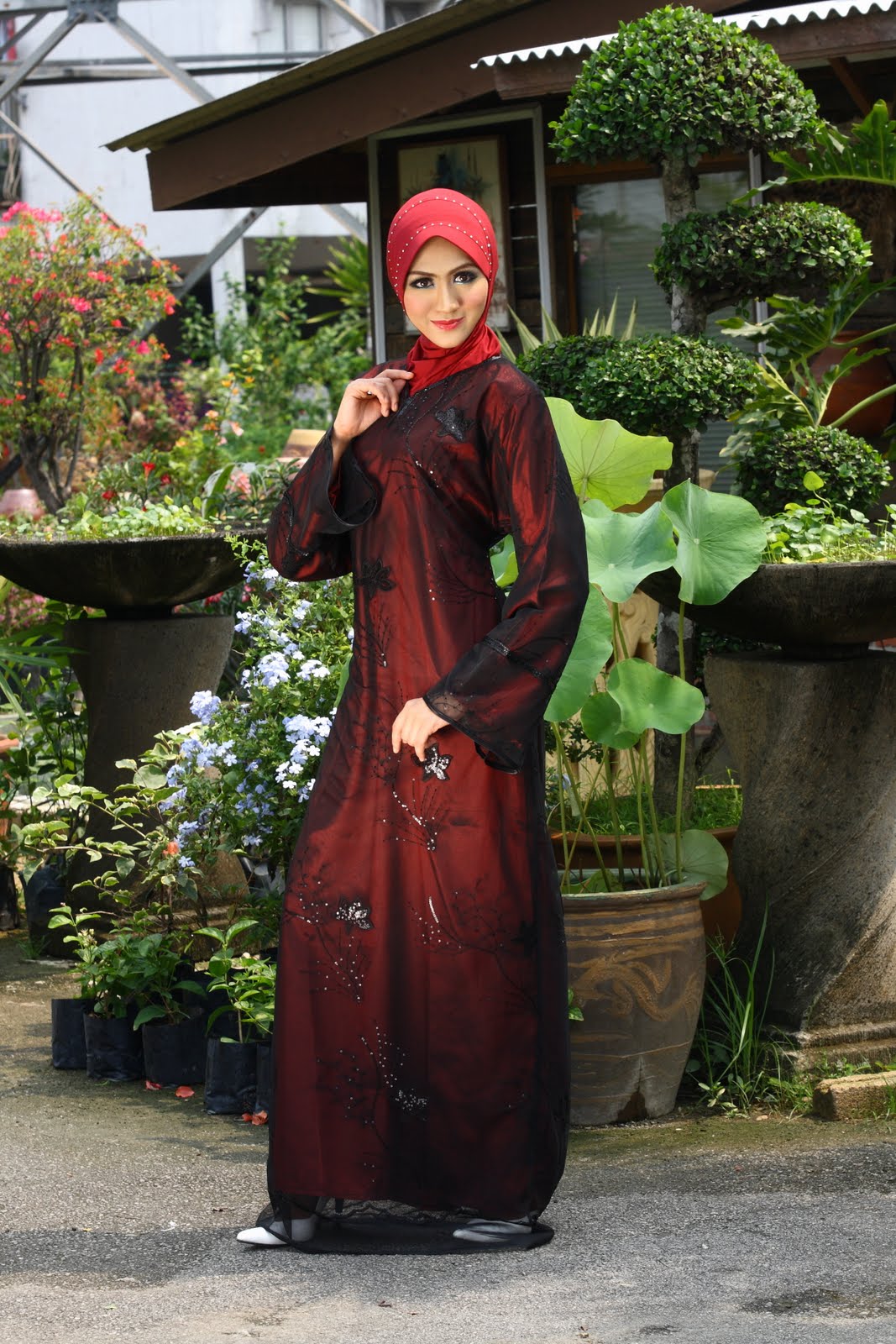
 The abaya, which is the most convenient Muslimah attire to wear in order to adhere to the hows of covering ones aurat, comes most commonly in black. Why? I have no idea! But it has been black since the time of Muhammad s.a.w. and it remained that way. It is not written in the al-Quran that it MUST be black. So, it now comes in several other colours with nice pretty designs. It is not haram if you want to wear a blue abaya, or purple, or pink, or brown, but remember!!!! Remember that the point of covering your aurat is so that you don't stand out. So, if you're in Saudi Arabia, where all women walk in a sea of black (top to bottom) wearing a coloured hijab and coloured abaya, while not haram, still makes you stick out from the crowd. But if you are in Malaysia, or Indonesia, or USA, Australia, colours are the norm. So, depending where you are, dress accordingly. Always remember the purpose of covering your aurat, and you'd rarely go wrong. But of course wearing bright pink even in Malaysia will still turn heads!
Makeup
What about makeup? Well, like I said, the whole purpose of wearing a hijab and if some choose, the niqab, is to cover your aurat which in turn is to decrease attracting attention to oneself. So, striking makeup would defy the whole point. Sure, khol is not haram... I think... unless you apply it like Cleopetra, then it's better that you don't. Lipstick... guess that depends on your husband or your father. But again... remember the purpose of covering your aurat...
Eyebrows
Plucking ones eyebrows!!! heheh... This, I find funny. Because, although it is haram, I still see many women, especially those from the middle east with nicely shaped eyebrows. Here's the hadith concerning plucking of eyebrows:
Al-Bukhaari (5931) and Muslim (2125) narrated that ‘Abd-Allaah ibn Mas’ood (may Allaah be pleased with him) said: “May Allaah curse the women who do tattoos and those who have them done, those who have their eyebrows plucked, and those who file their teeth for the purpose of beautification and change the creation of Allaah.”
It was stated in a Fatwa: Shaping the eyebrows by trimming, shaving or plucking their edges in order to appear beautiful, as is done by some women nowadays, is haraam because it involves changing the creation of Allaah and following the Shaytaan in his tempting of mankind to change the creation of Allaah.
Perfume
Perfume!!! This is haram. But I'm sure deodorant is fine and you can wear ALL the perfume you want when you're at home :P I'm sure your husband will love that!
Abu Moosa al-Ash’ari said: the Messenger of Allaah (peace and blessings of Allaah be upon him) said: “Any woman who puts on perfume then passes by people so that they can smell her fragrance, is an adulteress.”
Allah has given every woman their own beauty. It is up to a husband to see it. We have no right to change what Allah has given us especially if its not medically related. We can enhance it with makeup, creams, etc but only in the presence of the appropriate persons.
So, women, if you are looking for a love story, look no further. Islam has given you the most romantic, and beautiful love story there is, even better than Romeo and Juliet, as no one dies in the end. How? Your beauty is only for your husband. When you truly understand how that feels, it is definitely a very romantic feeling.

Every non-Muslim woman wonders why a Muslimah covers her hair.

Then the non-Muslim woman sees a Muslimah with the niqab: Oh, dear...
 Then she walks past a Muslimah in a full niqab (eyes covered as well): Oh, my...
I come from two worlds. There is a clear line drawn between these two worlds of mine: the old and the new. You see, for 23 years, I was a Roman Catholic; a denomination of Christianity that holds strong to its roots, traditions and the Catholic Bible. I was raised by a mother who grew up in a Catholic convent, I attended Sunday school, was baptized at the age of 12, confirmed at the age of 16 (I think), attended Sunday mass regularly, and attended a school originally founded by priests and nuns, located right next to a Cathedral. I knew my Our Father, my Hail Mary, etc... I was not exactly a fan of Muslims (stress on the word Muslims... not Islam) but because of that, my opinions on Islam varied accordingly.
Then all that stopped and ended, much to my mother's disappointment and my family's objection. On the 8th of October 2011, I did something all my high-school friends thought was the craziest thing I have ever done; I said my shahadah in front of my friends here in the university I attend. Some didn't know until the appointed 'imam' announced and lead me through my shahadah. Some cried, some smiled... I was just bemused.
So, given my history, I see things from two sides. I understand what a non-Muslim thinks about Muslims and Islam and I understand personally how it is being a Muslimah.
The aspect of my change is wide, it is not just a change of heart and fashion, but also a change in mentality and how I view what goes on in the world as well.
But since the topic I chose to share today is about the Hijab, I will stick to this. It is already a big topic but hey, I'm not Wikipedia :P
So...
The Hijab. I started wearing the hijab much earlier before I embraced Islam, say... 4 years prior to 2011? heheh... it just started out as curiosity. Since I was away from home, and for the first time in my life, I actually have Muslim friends who I feel close with. So I just thought why not? It'll be a new experience! And it was. It was not as uncomfortable as I imagined it would be and not ugly. With or without the hijab, I still felt pretty, but when I walk out the door with my hijab, it's a different kind of pretty. Something more private, something more mysterious and something more fulfilling.
Of course, that sparked a lot of talking among my friends and other students and some teachers as well. My Christian friends (at this time I was involved with many Christian programmes) were well, they weren't hostile but they didn't agree with my actions. I remember one friend, a senior suggesting that instead of wearing a hijab, I should wear the habit instead. That sparked quite a heated conversation between us and our friendship was never the same after that. But I stood my ground for as long as I could. It finally got too much so I stopped.
The hijab never really left me. The feelings stayed with me as I went through the roughest time my faith endured. It got so rough, to a point I refused to believe in anything.
Then 2011 came. For the first time since I went abroad for my studies, I decided to go for a trip. A bunch of my Muslim friends were going to Egypt during our winter holidays and within one day, I convinced my other friend (a Christian Chinese) to accompany me. So, we embarked on that trip, happy and excited, oblivious to the chaos that laid awaiting us in Egypt. But when Allah has a plan for you, you sometimes go blind: in my case, I ignored the news concerning the bombing in Domodedovo the day prior to our little group's departure for that same airport, and all 9 of us ignored the news about the uprising in Tunisia and Egypt.
Free from prying eyes and opinions, I was again free to wear my hijab. Oh, how wonderful it felt putting on my hijab as the Azhan rang in the air. And that was it, Egypt was my platform. I boarded the train and never turned back.
A persons journey to Islam may start with intense study of different religion, some through observing a Muslim friend closely, others through instant revelation, but my journey to Islam started with one simple piece of square cloth; the Hijab
1. The hijab
2. Aurat
3. Hijab styles
4. Abaya
5. Makeup
6. Eyebrows
7. Perfume
A hijab is not just a cloth that covers ones head, hair and neck, but it covers ones treasure. You know how we women treasure our beauty. We love being beautiful, that's why the cosmetic industry is one of the most marketable and profitable industries. Every woman on this earth loves looking pretty. But beauty differ according to culture and individual. Everyone has a certain beauty about them even if others do not see it. If you have a gold bar, you don't go showing it off, do you? No. Instead, you keep it in a safe, or in the bank behind several inches of metal. So, why should a woman's beauty be any different? It is HER treasure. So, in Islam, we say, hide it. Do not be common and decrease your value by showing it to just anyone. It is for you to share with your husband. That's the basic idea of a hijab. The most basic. To go further deeper, the hijab also helps the men. Girls, you know how men are, and men, you know yourself. A man sees a pretty lady, and he turns to look for a second time, looks at her face, then her chest, then that nice piece of *** then the oh so sexy slim legs. WOW!! that's a hot mama right there! It's how men are programmed. It's their natural instinct. If it stops there, then that's fine, but very few men just stop there. They continue to wonder how all that feels to his touch, etc. Majority have the discipline to control that basic human urge, but still, show some pity to the poor man!
If a woman is covered up from head to toe (not necessary in a burqa) what's there for a man to see? He can't know if she is to his liking or not. What chest to see? What *** to admire? What legs to stare at? It's all covered up, in long loose clothing. He can't see the pretty hair or the nice slim neck that's hidden under then hijab. He can't see the pretty lips curved in a smile behind the niqab. He can't see the pretty eyes sparkling behind the veil. What he can't see, he won't think about. When there's nothing for him to think about, he's not gonna have urges. Sisters, help your brothers, don't torment them with your beauty.
Not only that, you also earn their respect. A man will not disturb a woman who is covered up. He knows that she is not to be played with. He knows that she is to be respected. He knows that her dignity is to be honoured. We women dream of the knight in shining armour, the honourable gentlemen who treats his lady with respect. Well, there he is. He respects you, he honours you, but before you ask all that from a man, you have to show that respect and protect that honour yourself! That is why a Muslimah wears her hijab. That is why a Muslimah covers her aurat. Allah gave her beauty and she obeys and covers herself.
The hijab should be low enough to cover her chest. Why? It's obvious.
Aurat
When speaking about the hijab, we explain the aurat. Aurat is everything that should be covered. For women, it is everything except the face and hands. The FEET is also part of the aurat!! Though many of us forget that. So, a woman can be seen in public or by non-mahrams (men she can marry) when she is covered fully, except for her hands and face. So, the niqab is not compulsory, but should a woman choose to do so, then better for her. But if a woman is still not able to bring herself to such a level, then she looses nothing.
If a woman covers her head but wears a tight blouse or a short skirt with leggings, then her aurat is still exposed. She might as well just remove the hijab. To cover ones aurat, it is not just putting a cloth over it. The shape of the body should not be seen. You're not suppose to wrap your aurat, you're suppose to cover it. What's the point of wrapping the vase tightly with a cloth? You still know it's a vase even if you can't see it. Same with the aurat. A man can still see the shape of your ass and breasts when you wear something tight. He doesn't need to see flesh to imagine how good they look... he just needs the rough shape of it. So, a Muslimah should wear something loose.
Hijab styles

At the first few months, I wore the hijab in different styles. Everyday was a different fashion. But slowly, slowly, my hijab got longer and less stylish. Of course, when there's a celebration, the fashionista pop's back for a short visit :P
Why is this? Because the purpose of covering ones aurat, is to decrease attracting attention. So if your hijab is in some eye-catching colour or fashion, then it kinda defies the point. But it is still better than not wearing the hijab at all. Change takes time... this is very important especially to the Muslims!!! Muslims also need to be understanding to their new brothers and sisters whether reverting from a different religion or one starting to take back their roots in Islam. Come on too strong, and you will loose your ummah.
Abaya
Makeup
What about makeup? Well, like I said, the whole purpose of wearing a hijab and if some choose, the niqab, is to cover your aurat which in turn is to decrease attracting attention to oneself. So, striking makeup would defy the whole point. Sure, khol is not haram... I think... unless you apply it like Cleopetra, then it's better that you don't. Lipstick... guess that depends on your husband or your father. But again... remember the purpose of covering your aurat...
Eyebrows
Plucking ones eyebrows!!! heheh... This, I find funny. Because, although it is haram, I still see many women, especially those from the middle east with nicely shaped eyebrows. Here's the hadith concerning plucking of eyebrows:
Al-Bukhaari (5931) and Muslim (2125) narrated that ‘Abd-Allaah ibn Mas’ood (may Allaah be pleased with him) said: “May Allaah curse the women who do tattoos and those who have them done, those who have their eyebrows plucked, and those who file their teeth for the purpose of beautification and change the creation of Allaah.”
It was stated in a Fatwa: Shaping the eyebrows by trimming, shaving or plucking their edges in order to appear beautiful, as is done by some women nowadays, is haraam because it involves changing the creation of Allaah and following the Shaytaan in his tempting of mankind to change the creation of Allaah.
Perfume
Perfume!!! This is haram. But I'm sure deodorant is fine and you can wear ALL the perfume you want when you're at home :P I'm sure your husband will love that!
Abu Moosa al-Ash’ari said: the Messenger of Allaah (peace and blessings of Allaah be upon him) said: “Any woman who puts on perfume then passes by people so that they can smell her fragrance, is an adulteress.”
Allah has given every woman their own beauty. It is up to a husband to see it. We have no right to change what Allah has given us especially if its not medically related. We can enhance it with makeup, creams, etc but only in the presence of the appropriate persons.
So, women, if you are looking for a love story, look no further. Islam has given you the most romantic, and beautiful love story there is, even better than Romeo and Juliet, as no one dies in the end. How? Your beauty is only for your husband. When you truly understand how that feels, it is definitely a very romantic feeling.


